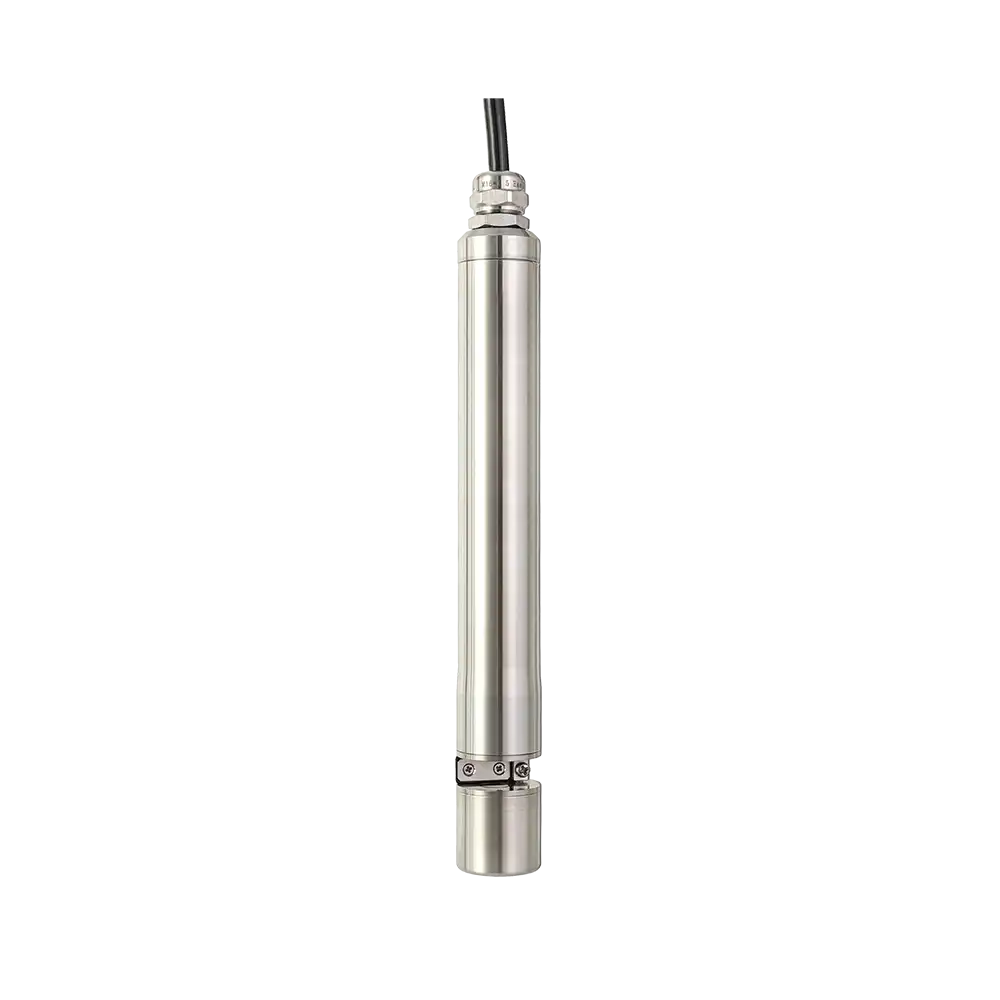


Water quality monitoring has evolved significantly with advancements in optical sensing technology. Among the most innovative tools available today is the full-spectrum water quality sensor. But what exactly is it, and how does it work? In this blog, we’ll explore the science behind full-spectrum sensors, their advantages over traditional methods, and their diverse applications in modern water management.
UV-Vis Spectroscopy: The Science Behind the Sensor
Light Energy and Wavelength
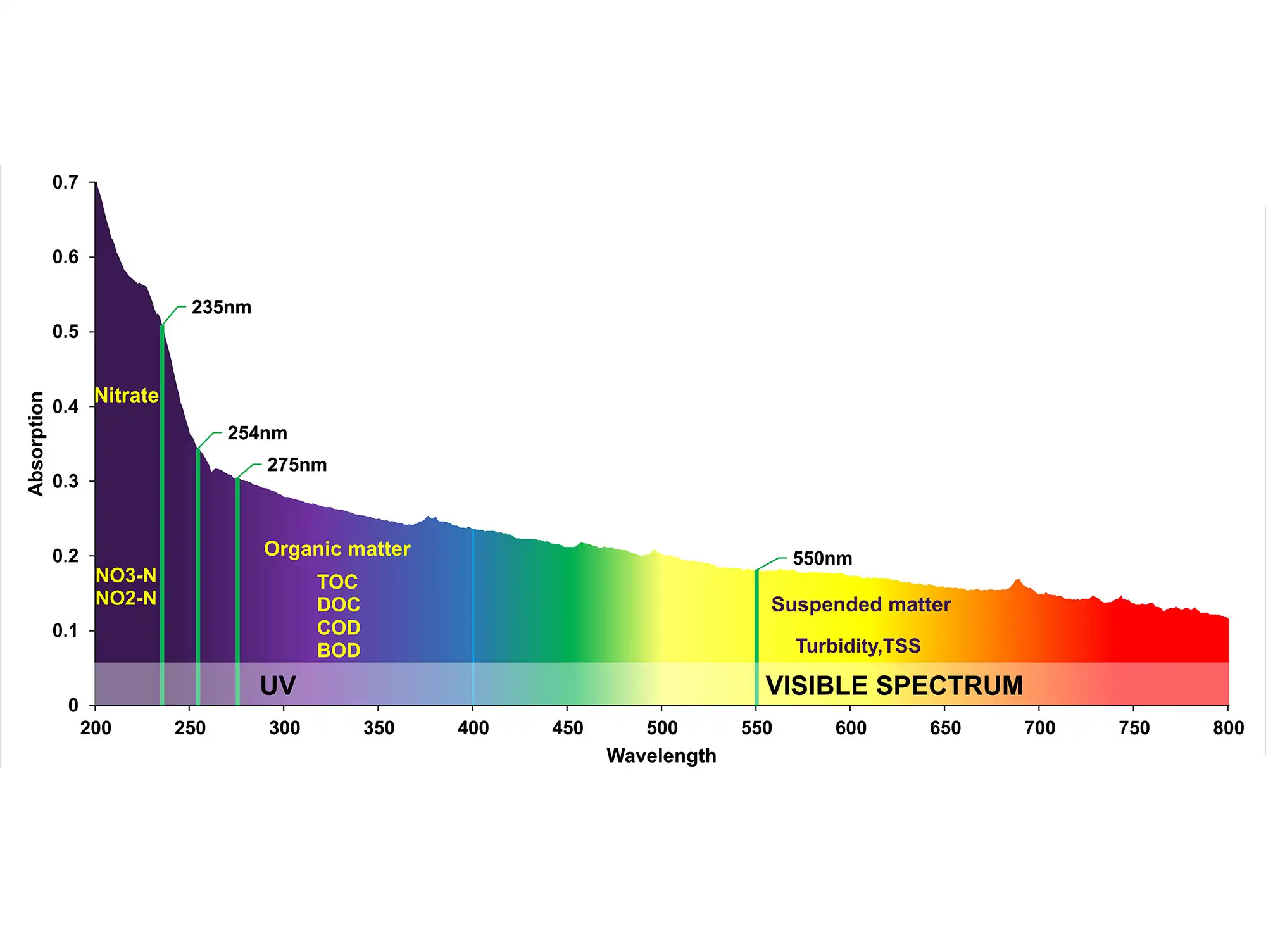
Ultraviolet-Visible (UV-Vis) light encompasses electromagnetic waves with wavelengths between 200 nm and 800 nm. The energy of light is inversely proportional to its wavelength—shorter wavelengths carry higher energy.
Molecular Energy Levels and Electron Transitions
Electrons in molecules exist at different energy levels. When UV or visible light passes through a substance, photons with specific energy levels can be absorbed, causing electrons to jump from a lower to a higher energy state.
Specific Absorption
This electron transition requires quantized energy—exactly matching the energy difference between two molecular orbitals. Since photon energy correlates with wavelength, each molecule absorbs only specific wavelengths of light.
Absorption Spectrum
By passing a continuous spectrum of UV-Vis light through a water sample and measuring absorption across wavelengths, we obtain an absorption spectrum. This spectrum acts like a water fingerprint, unique to the composition of the sample.
Lambert-Beer Law
According to this fundamental law, the absorbance of light is directly proportional to the concentration of the absorbing substance and the path length of the light through the sample.
These principles form the theoretical foundation of UV-Vis spectroscopy for water quality analysis.
Types of Optical Water Quality Sensors
Dual-Wavelength Sensors
These sensors measure absorbance at only two wavelengths—typically 254 nm and 550 nm. They are suitable for stable water bodies with simple organic content and low turbidity, such as surface water or treated wastewater.
Multi-Wavelength Sensors
These sensors include additional wavelengths such as 235 nm, 254 nm, 275 nm, and 550 nm. The extra wavelengths allow for the detection of nitrate nitrogen, making them slightly more versatile than dual-wavelength models.
Full-Spectrum Sensors
Full-spectrum sensors measure continuous absorbance across the entire 200–800 nm range, with a wavelength resolution of up to 1 nm. They can detect multiple parameters, including:
- COD (Chemical Oxygen Demand)
- TOC (Total Organic Carbon)
- DOC (Dissolved Organic Carbon)
- BOD (Biochemical Oxygen Demand)
- Turbidity
- TSS (Total Suspended Solids)
- BTX (Benzene, Toluene, Xylene)
- Hydrogen Sulfide
- Nitrate Nitrogen
- Color
These sensors are ideal for identifying influent characteristics in municipal and industrial wastewater, optimizing treatment processes, and enabling real-time monitoring.
Of course! Here is a comparative table based on the “Types of Optical Water Quality Sensors” section of your document. This table is designed to be clear, copy-paste friendly, and ready for use on your website or in presentations.
Comparison of Optical Water Quality Sensor Types
| Feature | Dual-Wavelength Sensor | Multi-Wavelength Sensor | Full-Spectrum Sensor |
|---|---|---|---|
| Wavelengths | 254 nm, 550 nm | 235 nm, 254 nm, 275 nm, 550 nm | 200 – 800 nm (Continuous, 1nm resolution) |
| Measured Parameters | Basic organics, turbidity | Basic organics, turbidity, Nitrate Nitrogen | COD, TOC, DOC, BOD, TUR, TSS, BTX, Hydrogen Sulfide, Nitrate Nitrogen, Color, etc. |
| Data & Calibration | Limited data; simple calibration | Limited data; basic calibration | Rich, continuous data; supports complex models & precise lab-based calibration |
| Water “Fingerprint” | No | No | Yes; can identify water types |
| Ideal Application | Stable, simple water (e.g., surface water, treated wastewater) | Similar to dual-wave, but with nitrate capability | Complex & variable water (e.g., industrial & municipal wastewater, influent characterization, process control) |
| Key Advantage | Cost-effective for specific, stable applications | Adds nitrate measurement | Maximum versatility, accuracy, and insight for complex monitoring |
Key Features of Full-Spectrum Water Quality Sensors
- ✅ 200–800 nm Full-Spectrum Measurement – Captures comprehensive spectral data for accurate analysis
- ✅ Water Fingerprint Identification – Recognizes water types based on spectral signatures
- ✅ Reagent-Free Operation – Eco-friendly, no chemical consumption
- ✅ Rapid Measurement – Results in as fast as 10 seconds
- ✅ Long Maintenance Interval – Built-in cleaning brush reduces fouling
- ✅ RS485 Communication – Easy integration with monitoring systems
- ✅ IP68 Protection – Suitable for harsh environments
- ✅ Low Power Consumption – Can be battery-operated for flexible deployment
Application Scenarios
- 🏭 Wastewater Treatment Plants – Inlet and outlet monitoring, process control
- 🏙️ Urban Pipe Network Monitoring – Real-time water quality tracking
- 🌊 River Basins, Surface Water, and Groundwater – Environmental monitoring
- 🚰 Drinking Water and Distribution Systems – Safety and quality assurance
- 🏭 Industrial Water Systems – Effluent and process water monitoring
Advantages of Full-Spectrum Sensors
Compared to Chemical Analyzers
- Speed – Measures in seconds, not hours
- Eco-Friendliness – No chemical reagents required
- Real-Time Capability – Ideal for process control and automation
Compared to Dual- and Multi-Wavelength Sensors
While all optical sensors differ from lab-based chemical methods, full-spectrum sensors excel in calibration and accuracy:
- Rich Data for Modeling – Continuous spectral data allows complex calibration using lab reference data, minimizing discrepancies.
- Water Fingerprint Recognition – Identifies and adapts to different water matrices, ensuring reliable performance in complex samples.
Conclusion
As the demand for real-time, accurate, and environmentally friendly water quality monitoring grows, full-spectrum water quality sensors are becoming the go-to solution for smart water management. Whether in wastewater treatment, watershed monitoring, or industrial applications, these sensors offer unmatched versatility and precision.